
Moisture Meter
Calibrated instruments that quantify exactly how wet building materials are
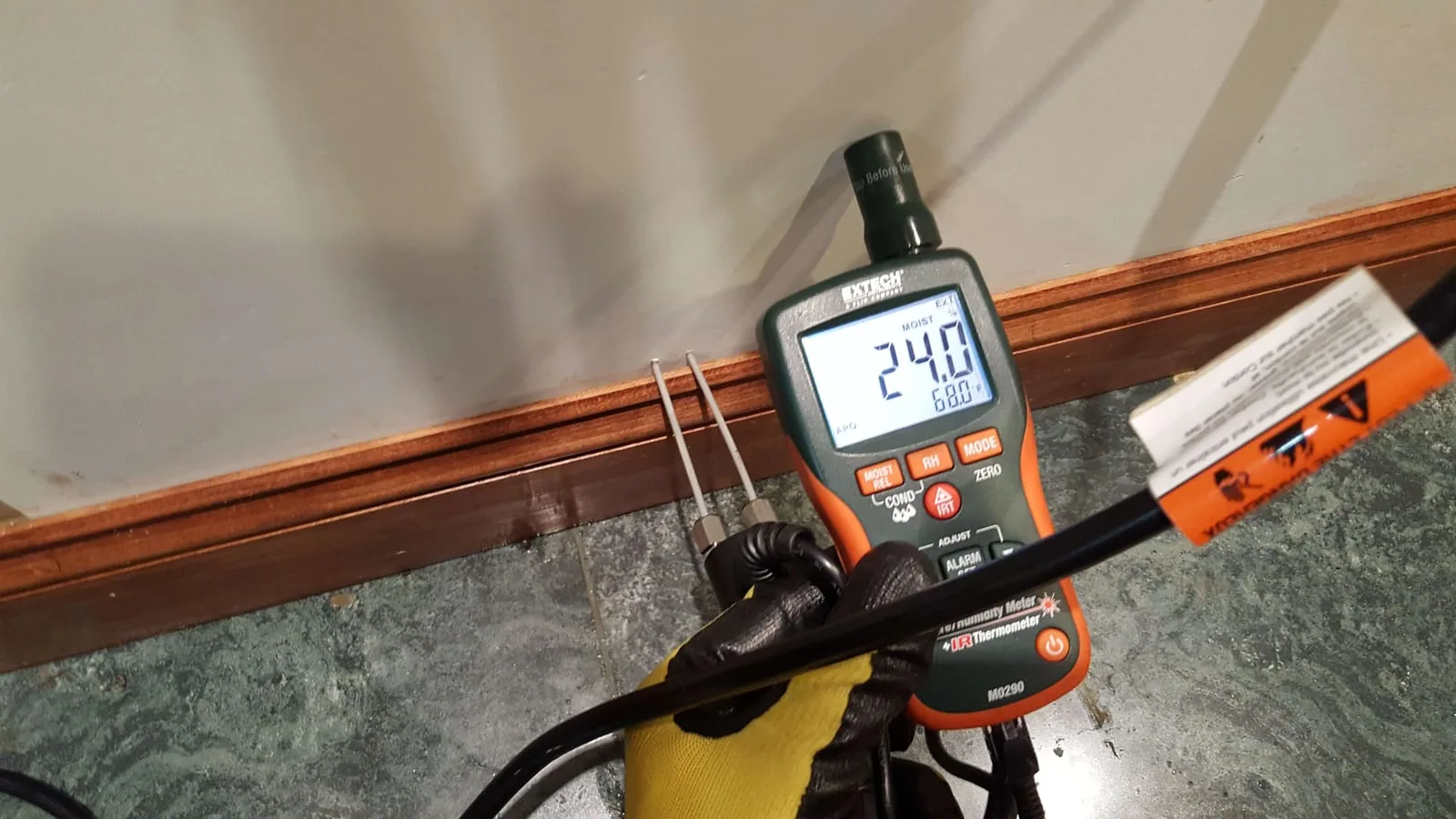
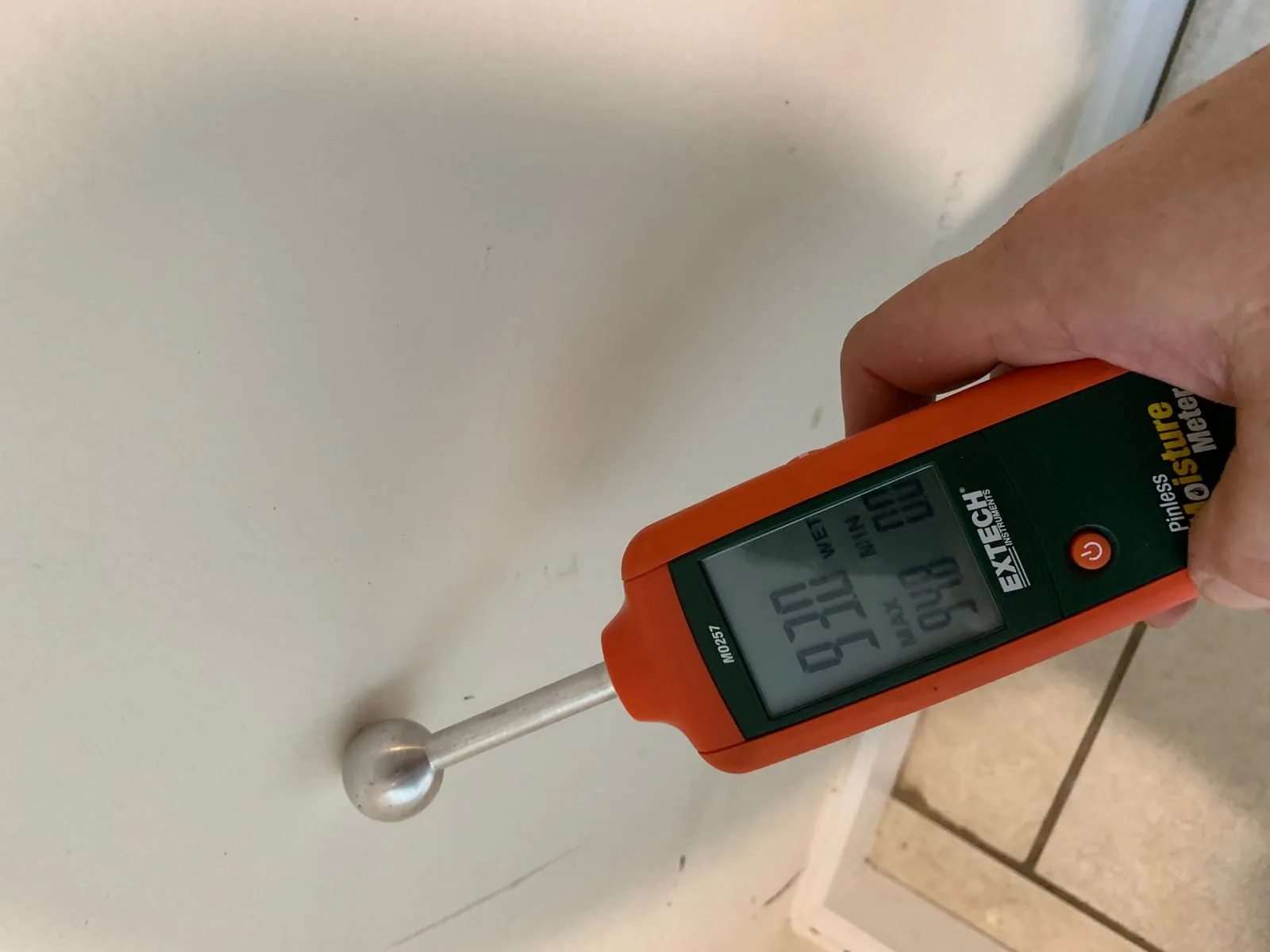
Moisture meters are the quantitative instruments that drive every restoration decision — whether to demolish or dry in place, when drying is complete, whether mold is likely to develop. Two types are commonly used: pin meters (penetrating — read direct moisture content of wood and other porous materials) and pinless / capacitance meters (non-penetrating — read relative moisture of wall surfaces without leaving holes).
Each has its use. Pin meters give a direct moisture-content percentage you can compare to IICRC drying targets (16% for framing lumber, 7-9% for hardwood flooring). Pinless meters scan walls non-invasively, comparing relative readings against a dry reference area of the same home to identify wet zones for further pin-meter investigation.
Every restoration job includes a moisture map: pin meter readings at marked test points throughout the affected area, recorded daily during drying. The map is what proves the structure is dry per S500. Without documented moisture meter readings, drying completion is unverifiable — and any follow-on mold claim becomes hard to dispute.
When we use it
- › Initial assessment to map the moisture footprint
- › Daily drying log readings at marked test points
- › Drying completion verification when all targets are met
- › Mold investigation to identify chronic moisture sources
- › Pre-renovation inspection to verify substrates are dry before finish work
How to read the output
Pin meters display moisture content as a percentage. IICRC S500 drying targets: 16% MC for framing lumber, 7-9% for hardwood flooring (within 2% of acclimatized baseline), 12-16% for plywood, 0.5-1.5% for concrete (via RH probe). Pinless meters typically display relative scale 0-100 — readings are compared against a dry reference area, with significant deltas indicating wet zones.
Models we typically deploy
- › Extech MO260 — workhorse pin/pinless dual-function meter
- › Tramex Moisture Encounter — pinless capacitance for wall scanning
- › Delmhorst BD-2100 — professional pin meter with species correction
- › Protimeter Surveymaster — combined pin + pinless + RH probe
Limitations
Pin meters leave small holes in the surface — generally not a problem on rough surfaces (framing, sub-floor) but can be objectionable on finished walls or hardwood. Pinless meters can't quantify absolute moisture content — they identify wet zones but don't tell you the precise percentage. Both meters can give false readings near metal (foil-backed insulation, electrical wires, plumbing) — always interpret in context.
Moisture Meter on real jobs
From 911 Storm restoration work in Fairfield County, CT and Westchester County, NY.
Common questions
Moisture Meter FAQ
What moisture content reading is 'dry' for framing?
IICRC S500 target for framing lumber (pine, fir, spruce) is ≤ 16% MC. Hardwood flooring target is within 2% of acclimatized baseline — typically 7-9% in Fairfield County. Plywood typically targets 12-16% MC. Concrete uses RH (relative humidity) probes rather than MC percentage.
Are pin meters more accurate than pinless?
For absolute moisture content, yes — pin meters give a direct reading you can compare to S500 targets. Pinless meters are better for fast scanning of large areas without leaving marks, but the readings are relative, not absolute. Best practice combines both: pinless to find wet zones, pin to quantify them.
Can a homeowner buy a moisture meter and check their own drying?
Consumer pin meters are available for $30-$200 and are accurate enough for general detection. The challenge for homeowner DIY use isn't the meter — it's the calibration, the interpretation of readings in context, and the IICRC standard target knowledge. For DIY damage drying after a small loss, a consumer meter helps confirm dryness; for any significant water damage that involves an insurance claim, professional documented readings are what the carrier requires.
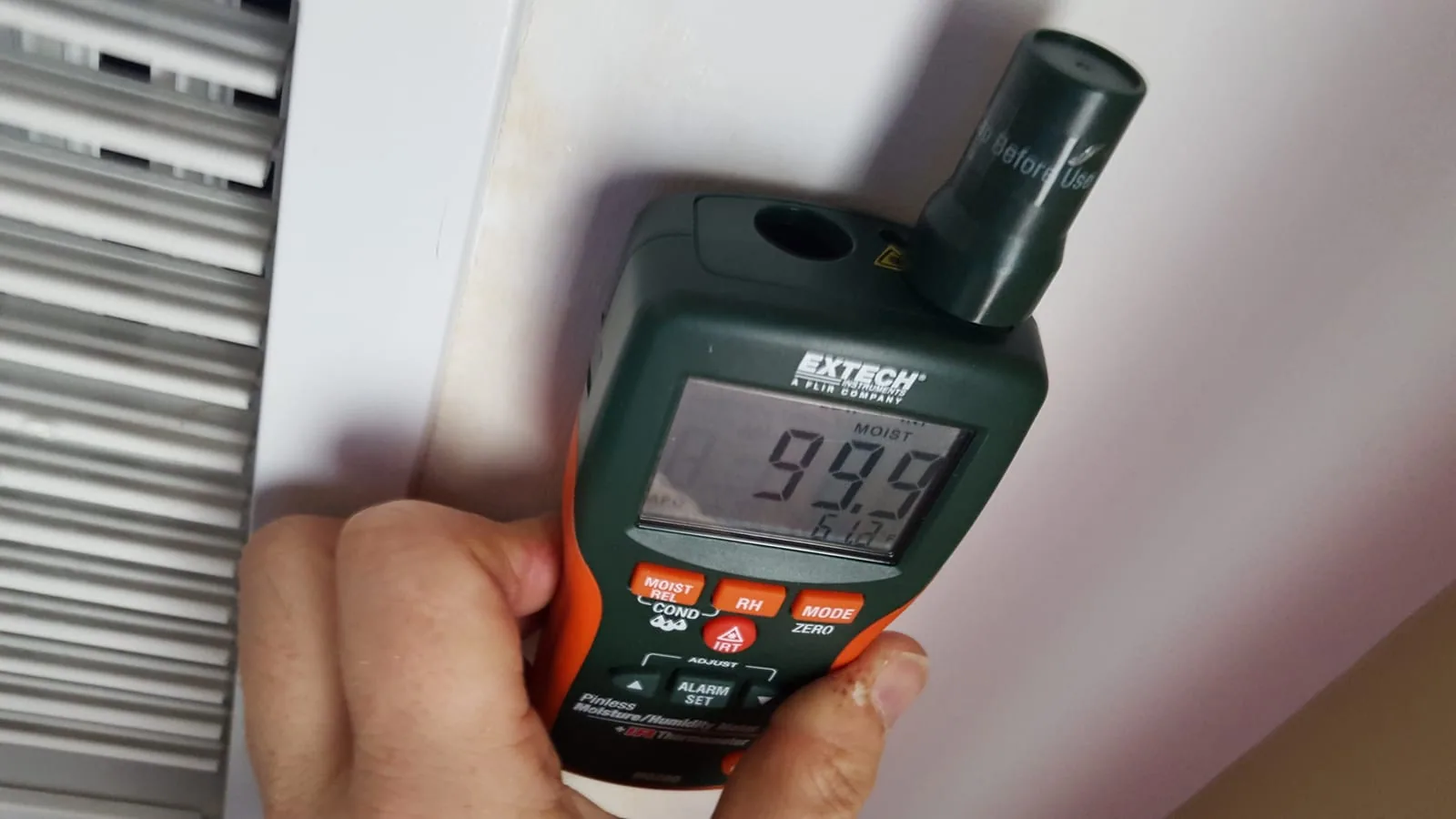
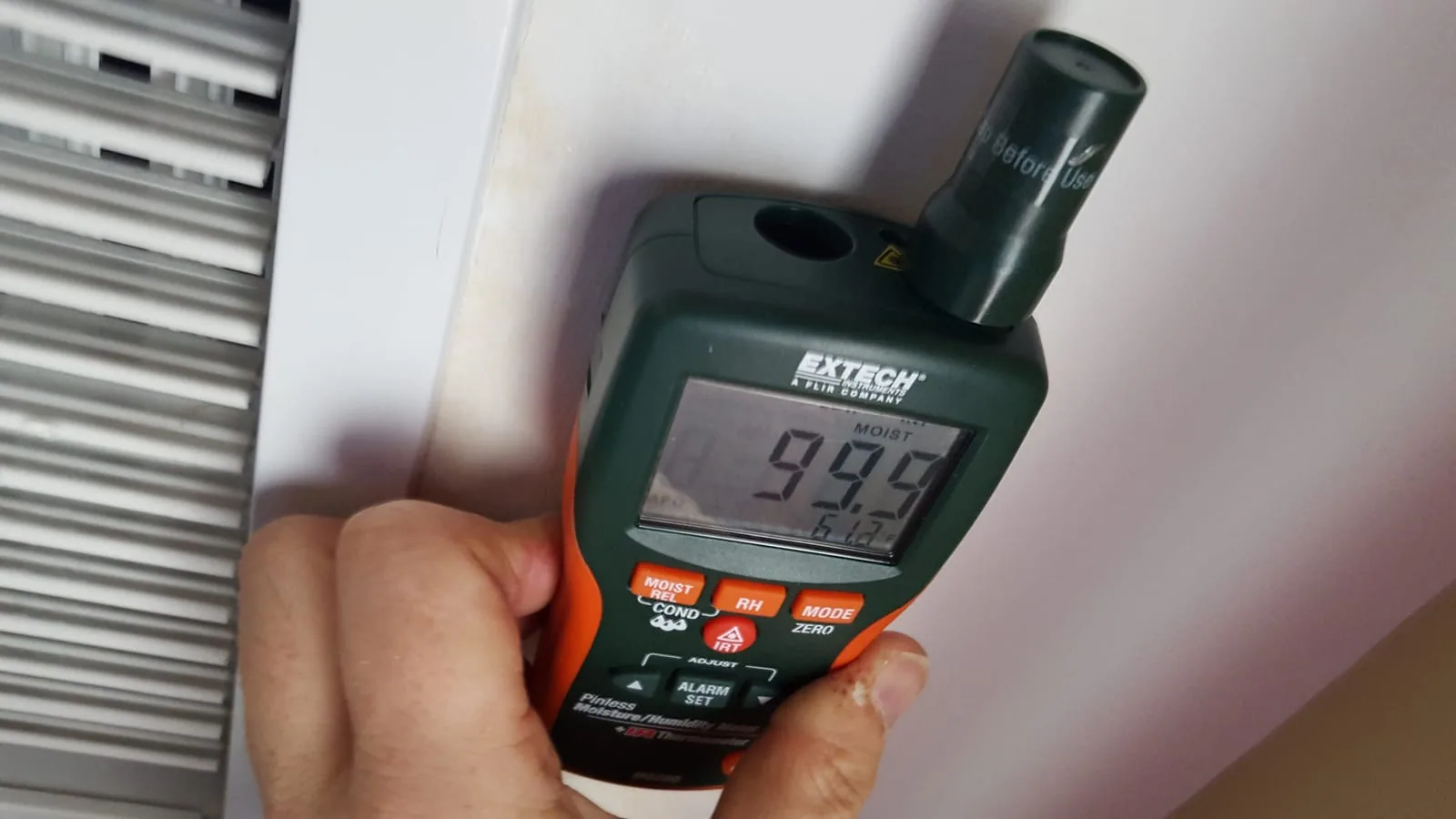
Why does the meter sometimes show 99% — that's not really 99%?
Meter scales max out at their upper detection limit, which is sometimes labeled '99' or 'OL' (over limit). It means the material is saturated beyond the meter's quantitative range — fully wet. The exact moisture percentage in saturated material is less important than the fact that it's saturated; the drying decision is the same either way.
See this equipment on your loss
Free on-site assessment with FLIR thermal + moisture mapping + Xactimate scope. 60-minute response across Fairfield County, CT and Westchester County, NY.
Call (203) 604-2474Other restoration equipment
Damage Doesn't Wait — Neither Do We
60-minute response. Free estimate. We handle your insurance claim.
IICRC Certified • Licensed & Insured • All Major Insurance Carriers