
Reference
Restoration Glossary
94 restoration industry terms explained in plain English. The IICRC standards your contractor references, the water categories your insurance adjuster uses, the equipment in our truck, the insurance language on your policy. The reference most restoration sites never bother to write.
IICRC Standards & Certifications13 terms
- #
IICRC— Institute of Inspection, Cleaning and Restoration Certification
The non-profit body that publishes the consensus industry standards for water, mold, fire, and smoke damage restoration. Insurance adjusters reference IICRC standards when scoping covered claims.
Founded in 1972, the IICRC writes ANSI-accredited standards used worldwide. Restoration technicians and firms can become IICRC-certified by passing standard-aligned exams and committing to continuing education. Active certifications are verifiable at iicrc.org/credentialverification.
- #
IICRC S500— Standard for Professional Water Damage Restoration
The ~250-page published industry standard governing water damage restoration. Defines water categories (1, 2, 3), drying targets per material, equipment minimums, and verification requirements.
Current version: S500-2021 (5th edition). Every legitimate water restoration in our market is documented to this standard. Two IICRC-certified contractors should reach roughly the same scope for the same loss if both are actually working to S500.
- #
IICRC S520— Standard for Professional Mold Remediation
The industry standard for professional mold remediation. Defines containment levels (1, 2, 3), demolition vs cleaning decisions, antimicrobial chemistry, and post-remediation verification requirements.
Current version: S520-2024 (~300 pages). Built on two core principles: "source removal beats source treatment" (remove porous moldy materials, do not just spray) and "contain the area, control the airflow" (work in negative-pressure containment so spores do not spread).
- #
IICRC S700— Standard for Professional Fire and Smoke Damage Restoration
The published industry standard governing post-fire cleanup, smoke residue characterization, HVAC decontamination, contents handling, deodorization, and the sequencing that determines whether a building actually ends up odor-free.
Current version: S700-2021. Identifies four smoke residue types (wet smoke, dry smoke, protein residue, fuel-oil soot), each requiring different cleaning chemistry. Mandates HVAC decontamination as part of the scope.
- #
WRT— Water Damage Restoration Technician
The foundational IICRC certification for water damage technicians. Covers S500 protocol, water classification, structural drying, and verification.
- #
ASD— Applied Structural Drying
Advanced IICRC certification beyond WRT. Covers psychrometric drying calculations, equipment sizing, and the science of evaporation in restoration contexts.
- #
AMRT— Applied Microbial Remediation Technician
The IICRC certification for professional mold remediation per S520. Covers containment, demolition decisions, antimicrobial chemistry, and PRV verification.
- #
FSRT— Fire and Smoke Restoration Technician
The IICRC certification mapped to S700. Required for legitimate fire and smoke damage restoration work.
- #
IICRC Certified Firm
Firm-level IICRC certification distinct from individual technician certification. Indicates the company itself meets ongoing compliance, insurance, and continuing-education standards.
- #
RRRP / EPA Lead-Safe— Renovation, Repair and Painting Rule
EPA Lead-Safe Certified Firm credential required for any contractor disturbing painted surfaces in pre-1978 housing. Critical for Fairfield County's significant pre-1978 housing stock.
- #
RIA— Restoration Industry Association
Trade association for restoration contractors. Distinct from IICRC (which is the standards/certification body). RIA membership signals industry engagement but is not a technical credential.
- #
NADCA— National Air Duct Cleaners Association
Trade association publishing the standard for HVAC duct cleaning. Cited in S700 fire restoration scopes when HVAC decontamination is performed.
- #
NORMI— National Organization of Remediators and Mold Inspectors
Industry membership organization for mold inspectors and remediators. Less widely held than IICRC S520 but appears in some Florida and Sunbelt licensed-state contractor stacks.
Water Damage21 terms
- #
Category 1 Water (Clean)
Water from a sanitary source at the time of release. Supply line break, rainwater intrusion, refrigerator overflow, melting ice. Most materials can be dried in place if mitigation starts within 48 hours.
- #
Category 2 Water (Gray)
Water containing significant chemical, biological, or physical contamination. Washing machine discharge, dishwasher overflow, sump pump discharge. Requires antimicrobial application and often demolition of porous absorbent materials.
- #
Category 3 Water (Black)
Grossly contaminated water. Sewage backup, toilet overflow, rising surface flood, river water. Requires full PPE, demolition of all porous materials the water touched, antimicrobial of all remaining surfaces, biohazard disposal.
- #
Class 1 Water Loss
Smallest amount of water absorption and evaporation. Affected zone is partially wet with low-porosity materials (concrete, vinyl). Lowest drying complexity.
- #
Class 2 Water Loss
Significant water absorption affecting an entire room. Carpet and cushion present. Water wicked up walls less than 24 inches.
- #
Class 3 Water Loss
Greatest amount of water absorption. Ceilings, walls, insulation, and subfloors all saturated. Water source from above (burst supply line on upper floor).
- #
Class 4 Water Loss
Specialty drying scenarios — materials with low porosity that hold water (hardwood, plaster, concrete). Requires extended drying times and specialty equipment.
- #
Extraction
Mechanical removal of standing water using truck-mounted or portable extractors. First operational step of any water damage mitigation. A typical truck-mounted extractor moves 500+ gallons per minute.
- #
Structural Drying
The phase of water mitigation where remaining moisture in building materials is removed via dehumidification and airflow until IICRC S500 target moisture content is reached.
Typical residential structural drying runs 5-10 days with LGR dehumidifiers and axial air movers operating continuously. Daily moisture-meter readings at marked test points track progress against S500 target MC.
- #
Moisture Content (MC)
The percentage of water in a material by weight. Measured with calibrated pin or pinless moisture meters. IICRC S500 drying targets: framing lumber ≤16% MC, hardwood flooring 7-9% MC.
- #
Drying Target
The IICRC S500-defined moisture content level a material must reach before drying equipment is removed. Framing 16% MC, hardwood 7-9%, drywall baseline-comparison.
- #
Flood-Cut
Demolition of wet drywall above the water line — typically 12 inches above the highest water mark (minimum 4 inches per IICRC S500). Exposes wall cavity for inspection and drying.
- #
Hydrostatic Pressure
Groundwater pressure pushing against foundation walls. Drives chronic basement seepage particularly in clay-heavy soils common in backcountry Greenwich, Round Hill, and inland Fairfield.
- #
Efflorescence
White chalky mineral deposits on basement walls — left behind when water passes through concrete or block. Visual indicator of active water infiltration through the foundation even without visible flooding.
- #
Ice Dam
Ridge of ice that forms on a roof edge during winter freeze-thaw cycles. Forces snowmelt back under shingles into attic insulation and ceiling drywall below. Most common late-January / February Fairfield County water loss cause.
- #
Burst Pipe
Supply line failure under pressure — typically 40-80 PSI residential. Releases 15-30 gallons per minute on a 1/2-inch line. Single hour unattended = 800+ gallons across multiple floors.
- #
Sump Pump Failure
Failure of basement sump pump to operate during groundwater inflow. Common during power outage + heavy rain combination. Requires the water-backup endorsement on homeowner policy to be a covered loss.
- #
Battery Backup Sump Pump
Secondary sump pump powered by battery for use during power outages. Typically buys 6-12 hours of operation. Strongly recommended for any home with a finished basement.
- #
Sewage Backup
Wastewater backflow into a building through floor drains or fixtures, caused by municipal sewer surcharge, line blockage, or backwater valve failure. Always Category 3 water requiring full biohazard protocol.
- #
Backwater Valve
One-way valve installed on a basement main drain preventing municipal sewer surcharge from flowing back into the home. $500-$2,000 installed. Common preventive add-on after a sewer backup event.
Mold Remediation13 terms
- #
Stachybotrys chartarum
Toxin-producing mold species commonly called "black mold." Always triggers IICRC S520 Level 3 containment regardless of visible square footage. Associated with mycotoxin exposure and chronic indoor air quality issues.
- #
Aspergillus
Genus of common indoor and outdoor mold. Some species (e.g. A. fumigatus) cause infection risk in immunocompromised individuals. Standard S520 Level 2 protocol applies for typical residential growth.
- #
Penicillium
Common indoor mold genus, often found alongside Aspergillus. Allergenic; produces musty odor. Frequent finding in chronically humid basements and HVAC systems.
- #
Cladosporium
Most common outdoor mold genus. Frequently found indoors at low background levels. Standard S520 Level 1-2 protocol typically applies.
- #
Chaetomium
Water-damage indicator mold species. Often found alongside Stachybotrys at chronically wet sites. Triggers S520 Level 2-3 protocol depending on coverage.
- #
Mycotoxin
Toxic compound produced by certain mold species (notably Stachybotrys, some Aspergillus). Associated with chronic exposure symptoms even after visible mold is removed. Addressed by Goldmorr AIM protocol when standard S520 is insufficient.
- #
Goldmorr AIM— Antimicrobial Injection Method
Multi-stage specialty remediation protocol designed to neutralize mycotoxins, not just kill visible mold. Used for chronic exposure cases where standard S520 cleaning leaves residual toxin burden.
- #
Source Removal
IICRC S520 primary remediation method — physical removal of porous moldy materials (drywall, carpet pad, insulation) rather than cleaning in place. The hyphae penetrate porous substrates and cannot be reliably cleaned out.
- #
Encapsulation
Sealing remaining moldy surfaces under antimicrobial coating after source removal. Appropriate as a supplemental treatment for materials that cannot be removed (load-bearing framing). NOT a shortcut to skip demolition.
- #
Post-Remediation Verification (PRV)
Independent third-party testing performed before mold remediation containment is dismantled. Visual inspection, moisture readings, and air sampling — indoor spore counts compared to outdoor baseline. The only objective proof remediation succeeded.
- #
Spore-Trap Sampling
Air quality sampling technique using calibrated cassette + constant-flow pump (typically 5-10 minutes). Indoor samples compared against outdoor baseline collected same day. Lab quantifies spore counts per cubic meter.
- #
Surface Sampling
Tape lift or swab sample taken from visible mold growth for laboratory species identification. Best when the question is "what species is this?" Differs from air sampling, which measures airborne spore concentration.
- #
Bulk Sampling
Physical sample of contaminated material (cut piece of drywall, batt of insulation) submitted to a lab. Allows analysis of how deep the contamination has penetrated the substrate.
Fire & Smoke10 terms
- #
Wet Smoke
Low-heat smoldering fire residue from plastic and rubber. Sticky, smeary, very pungent. Hardest residue type to remove — requires solvent-based cleaners and chemical sponging.
- #
Dry Smoke
Fast, high-heat fire residue from paper and wood. Powdery, less pungent, easier to clean but spreads further (lighter particles airborne longer). HEPA vacuum first, then dry chemical sponge.
- #
Protein Residue
Practically invisible film deposited by kitchen fires involving food. Extreme odor. Requires specialty enzymatic cleaners — standard chemistry does not remove it effectively. Surface looks clean while continuing to off-gas odor for months without proper treatment.
- #
Fuel-Oil Soot
Very fine residue from oil-furnace puff-back malfunction. Distributed throughout the home via HVAC. Mildly acidic — slowly corrodes electronics. Requires extensive HVAC decontamination plus surface cleaning.
- #
Chimney Puff-Back
Oil-fired furnace ignition malfunction sending a back-puff of unburned fuel and soot through the chimney and into the home. Common in older Fairfield County homes still on oil heat.
- #
HVAC Decontamination
Full cleaning of HVAC system after fire/smoke event — duct cleaning per NADCA standard, coil cleaning, blower motor cleaning, filter replacement. Required by S700; skipping it causes smoke odor to recirculate indefinitely.
- #
Thermal Fogging
Deodorization method using heated deodorizing solvent fogged into a sealed space. Penetrates the same micro-cracks smoke originally entered. Requires evacuation during treatment. Considered the gold standard for whole-room embedded smoke odor.
- #
Hydroxyl Generator
UV-based deodorization device producing hydroxyl radicals from ambient humidity. Neutralizes VOCs continuously. Safe to run with occupants present. Slower than thermal fogging but no displacement required.
- #
Ozone Treatment
Powerful oxidizing deodorization. Highly effective for stubborn residual odor. Requires full evacuation during treatment and thorough ventilation after — ozone is harmful to humans and pets.
- #
Chemical Sponge
Specialty dry-cleaning sponge for lifting smoke residue from surfaces without spreading it. Used before any wet cleaning in S700 protocol — wet cleaning first drives residue deeper into porous materials.
Containment & Structural8 terms
- #
Level 1 Containment
IICRC S520 protocol for mold remediation under 10 square feet. Plastic sheeting around the work zone, dust suppression, debris bagged for disposal.
- #
Level 2 Containment
IICRC S520 protocol for 10-100 sq ft mold growth. Full floor-to-ceiling poly sheeting with zippered access, HEPA air scrubber maintaining negative air pressure, HVAC sealed off, crew in N-95 respirators minimum.
- #
Level 3 Containment
IICRC S520 protocol for 100+ sq ft, or any Stachybotrys regardless of size. Double-layer poly with airlock entry, multiple HEPA scrubbers, full PPE (Tyvek + full-face P100), decontamination chamber for exit, always paired with PRV.
- #
Negative Air Pressure
Air pressure inside a containment chamber lower than surrounding ambient pressure. Air flows INTO the containment, not out — preventing spore or contaminant migration to unaffected areas during demolition. Maintained by HEPA scrubber.
- #
Personal Protective Equipment (PPE)
Tyvek suits, N-95 or P100 respirators, full-face masks, boot covers, double gloves. Required for Cat 2/Cat 3 water work, all Level 2+ mold remediation, post-fire cleanup.
- #
Decontamination Chamber
Small interim airlock at the entry to Level 3 mold containment. Crew enters work zone through chamber, removes PPE on exit in chamber, prevents contamination from leaving the containment.
- #
Antimicrobial
EPA-registered product applied to surfaces during Cat 2/Cat 3 water work and mold remediation. Common categories: quaternary ammonium ("quats"), hydrogen peroxide-based, botanical (thymol). Application records (product, area, dwell time) required per S500/S520.
- #
Biohazard
Material contaminated with infectious agents — sewage, blood, bodily fluids, mold-contaminated debris. Requires sealed bagging, regulated disposal, and crew in full PPE.
Equipment & Instruments12 terms
- #
HEPA Air Scrubber
Industrial filtration unit that pulls room air through a HEPA filter (99.97% efficiency at 0.3 microns) then exhausts filtered air outside containment. Maintains negative air pressure during mold and Cat 3 work.
Industry guideline: 4-6 air changes per hour of containment volume. A 1,000 cubic-foot containment needs 4,000-6,000 CFM of HEPA filtration (typically 1-2 scrubbers).
- #
LGR Dehumidifier— Low Grain Refrigerant
Industrial dehumidifier that operates effectively in cold (down to ~40°F) and extracts significantly more moisture per kWh than standard refrigerant units. The workhorse of restoration drying.
Common models: Phoenix 200, Dri-Eaz Drizair 1200, BlueDri BD-76. Industry sizing rule: one LGR per 800-1,200 cubic feet of contained space.
- #
Desiccant Dehumidifier
Dehumidifier using desiccant wheel rather than refrigerant cycle. Works in extreme cold (below 40°F) where LGR units fail. Used for cold-environment drying and very-low-humidity industrial applications.
- #
Air Mover
High-velocity restoration fan. Pairs with dehumidifier to refresh moisture-laden boundary layer at wet surfaces so evaporation can continue. Industry rule: ~1 air mover per 50-70 sq ft of wet surface.
- #
Axial Fan
Air mover with high airflow / lower static pressure. Best for open-room drying. Most common air mover type on residential losses.
- #
Centrifugal Fan
Air mover with higher static pressure than axial. Used to force air through hose attachments into wall cavities, under floors, or through containment chamber walls.
- #
FLIR Thermal Camera
Thermal imaging camera (FLIR is the dominant brand) showing surface temperatures as a heat-map image. Wet materials read cooler than dry surroundings due to evaporative cooling — used for non-invasive hidden-moisture mapping.
- #
Pin Moisture Meter
Penetrating moisture meter reading direct moisture content of wood and other porous materials. Quantitative reading in % MC. The instrument that produces the numbers in your daily drying log.
- #
Pinless Moisture Meter
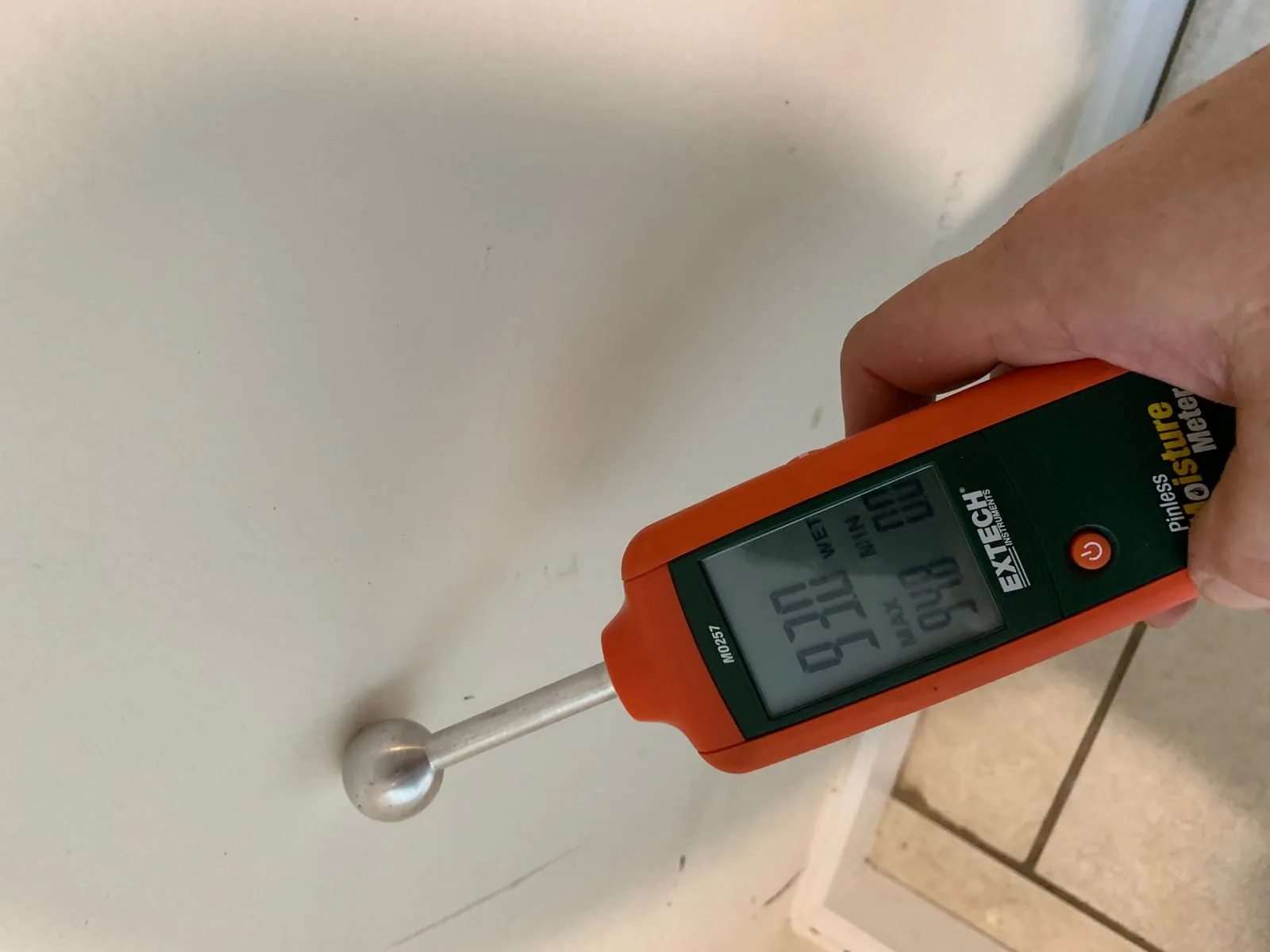
Capacitance moisture meter that scans surface relative moisture without leaving holes. Best for fast scanning of finished walls and floors. Readings are relative — pin meter is used to confirm with quantitative MC.
- #
Psychrometric Chart
Chart relating air temperature, relative humidity, dew point, and grains of moisture per pound of air. Foundation of structural drying calculations — IICRC ASD certification covers practical use.
- #
Thermo-Hygrometer
Combined temperature and humidity meter. Daily readings of ambient temp and RH inside the drying chamber are recorded for the drying log alongside material moisture content.
- #
PM2.5 / PM10 Air Quality Meter
Real-time particulate matter monitor. Used during mold remediation to verify containment is working (no particulate migration out of the work zone) and at post-remediation clearance to verify air quality has returned to baseline.
Insurance & Claims17 terms
- #
Xactimate
Industry-standard estimating software used by insurance adjusters and restoration contractors. Produces line-item priced scopes by region. Submitting an Xactimate-documented scope is the standard expectation across all major carriers in our market.
- #
First Notice of Loss (FNOL)
Initial report to your insurance carrier opening a claim. Triggers claim number assignment and adjuster dispatch. Should happen within 24-48 hours of discovering the loss.
- #
Claims Adjuster
Insurance company employee (or contracted independent) who scopes the loss, reviews contractor estimates, and authorizes coverage. Different from a Public Adjuster (works for the homeowner).
- #
Public Adjuster
State-licensed adjuster who works FOR the policyholder (not the carrier). Typical fee 8-15% of the recovery. Worth considering for claims over $50K or where the carrier's adjuster is acting in bad faith.
- #
Deductible
Amount the policyholder pays before insurance coverage applies. Typical CT/NY homeowner deductibles: $500-$2,500 standard, $5,000-$25,000 on HNW policies. Hurricane deductible is separate (see below).
- #
Hurricane Deductible
Separate percentage-based deductible (typically 1-5% of dwelling) on coastal CT and NY policies. Triggers only when the National Weather Service officially declares a hurricane affecting the state — NOT triggered by typical nor'easter wind events.
- #
Mold Sublimit
Maximum amount homeowner insurance pays for mold remediation, separate from broader water-loss coverage. Typical CT/NY range: $5,000-$25,000 standard, $25,000-$50,000+ on HNW carriers, with optional buy-up endorsements raising the cap.
- #
Water-Backup Endorsement
Add-on coverage required for sewer backup and sump pump failure losses to be covered. Standard policies exclude these scenarios without this endorsement. Typical annual premium $100-$300.
- #
Ordinance or Law Endorsement
Coverage for code-upgrade reconstruction triggered by damage to older buildings. Without this endorsement, the carrier pays only like-for-like restoration and the homeowner absorbs code-delta costs.
- #
Additional Living Expense (ALE)
Homeowner policy coverage paying temporary housing, restaurant meals, pet boarding, and other costs while the home is uninhabitable. Typically capped at 20-30% of dwelling coverage. Keep all receipts.
- #
Business Interruption (BI)
Commercial property coverage replacing lost income during closure period. Typically activates after 24-72 hour waiting period. Paired with property scope on restaurant, hotel, retail, and office restoration claims.
- #
Supplement
Addendum to an original Xactimate scope after work begins and hidden damage is discovered. Typically comes in 20-40% above the original scope. Standard practice on water and fire losses, usually approved without dispute when properly documented.
- #
Replacement Cost vs Actual Cash Value— RC vs ACV
ACV = replacement cost minus depreciation (carrier pays less for old/worn items). RC = full cost to replace with like-kind-and-quality. RC policies typically pay ACV upfront and release depreciation after the replacement is actually completed.
- #
Depreciation
Reduction in payout reflecting the age/wear of damaged property. Recoverable on RC policies after replacement is completed; non-recoverable on ACV policies. Documenting the actual replacement triggers the depreciation release.
- #
Subrogation
Insurance carrier pursuing recovery from a responsible third party after paying the policyholder's claim. Example: carrier pays for burst-pipe damage, then pursues the plumber whose defective work caused the failure.
- #
Preferred Vendor / TPA
Restoration contractor enrolled in a carrier's preferred vendor network. Homeowners have free choice of contractor by federal contract law — preferred vendor programs are offered as convenience, not requirement.
- #
Direct Billing
Restoration contractor invoices the insurance carrier directly rather than the homeowner. Homeowner pays only the deductible. Requires established billing relationship between contractor and carrier.
Term you don't see here?
We add terms regularly. If your adjuster used a word you couldn't parse, or your contractor cited a standard you want explained, call and we'll walk you through it in plain English.
(203) 604-2474Damage Doesn't Wait — Neither Do We
60-minute response. Free estimate. We handle your insurance claim.
IICRC Certified • Licensed & Insured • All Major Insurance Carriers